How to set priorities in life when everything matters
Share this page if it might be helpful to someone.
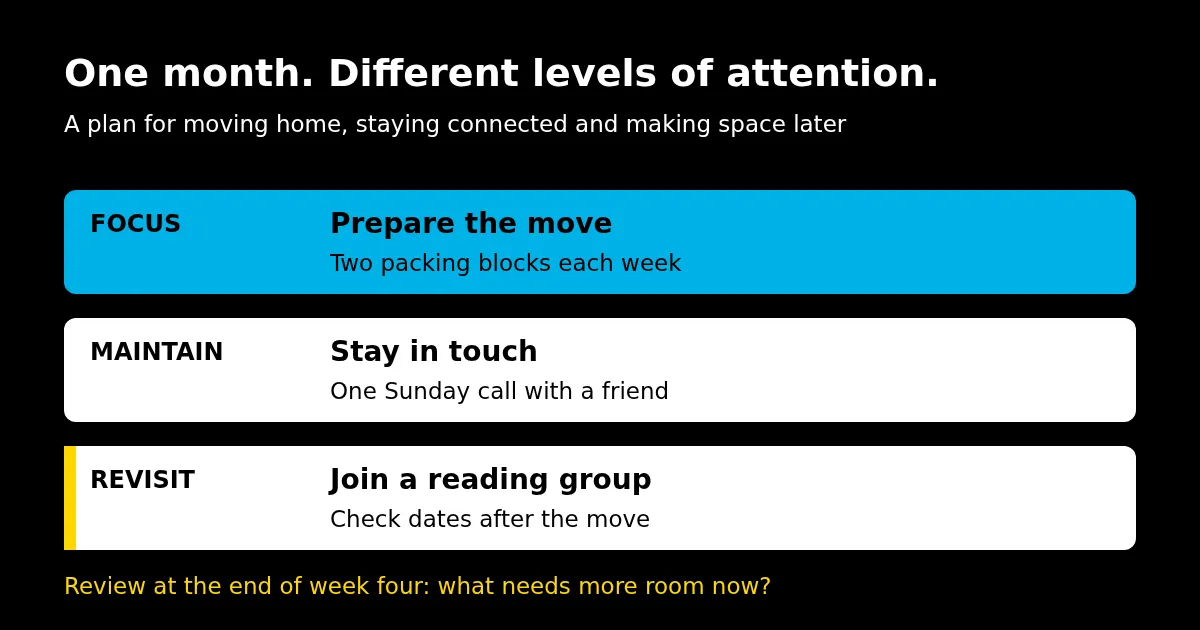
You want to make room for several things that matter, but your week is already full. To set priorities in life, decide what needs more attention for a defined period, what you want to maintain, and what you can deliberately postpone. Keep existing responsibilities in view, put your choices into your calendar, and set a date to review them.
What is a life priority?
A life priority is something you choose to give attention to ahead of competing demands. A value describes what matters to you, such as friendship or creativity; a priority describes where you will put your attention now. You can value both without giving each the same amount of time this month.
“Family, work, friends and learning” names important areas. “This month I will prepare for my move while keeping a weekly call with a friend” makes a choice you can act on.
How to set priorities in life for the next four weeks
Use four weeks as a manageable planning window for this exercise, not as a rule you must follow. If a decision is due sooner, use that deadline instead.
1. Name what is asking for your attention
Write down the commitments, changes and wishes occupying your mind. Beside each, answer two questions: “Why does this matter to me?” and “What would happen if I gave it less attention during this period?”
Separate an agreed responsibility from an optional ambition. Caring for someone who depends on you is different from wanting to start another project. If an obligation feels unclear, check what has actually been agreed before treating it as something you can drop.
2. Choose a focus, a maintenance level and a later date
Give each item one of these roles:
- Focus: something you want or need to move forward now. Name a visible result for the end of the period.
- Maintain: something you want to keep present without expanding it. Describe what a workable level of attention looks like.
- Revisit: something you are postponing. Give it a review date so “later” does not mean forgetting it.
Start with one main focus. Add another only if you can show where the time will come from. Maintenance should reflect real needs and agreements, including those of anyone affected by your choice.
3. Check the plan against your actual week
Look at work, travel, care, household tasks and existing commitments before adding new blocks. Put your focus and maintenance actions into the space that remains. Leave some room for changes rather than allocating every available hour.
If the plan doesn't fit, reduce the scope or reconsider the timing. Ask: “What will I do less of to make this possible?” A new priority needs an answer to that question, not just another calendar entry.
4. Tell anyone affected what is changing
Keep the message specific: what you can offer, what you cannot take on, and when you will revisit it. For example: “I'm preparing for the move this month, so I can't organize our next group outing. I'd like to keep our Sunday call and look at plans again after moving day.”
Where you share a responsibility, discuss the change rather than assuming someone else will absorb it.
Example: a move, a friendship and a reading group
Suppose you are moving home in four weeks. You also want to reconnect with a friend and join a reading group. Your usual responsibilities continue, and you have two free blocks during the week plus some time on Sunday.
Scroll sideways if needed to read all columns. The comparison labels stay visible on the left.
| What matters | Role for these four weeks | Action |
|---|---|---|
| Being ready for moving day | Focus | Use the two weekday blocks to sort and pack, starting with items you rarely use |
| Staying connected with a friend | Maintain | Ask whether a Sunday call would work for both of you |
| Meeting people through reading | Revisit | Save the group's contact details and check its next dates after the move |
In week one, you reserve the packing blocks, confirm a call time with your friend and record the reading-group review date. You don't add the group meeting on top of a week that is already allocated.
At the end of week four, review what actually happened. If unpacking still needs attention, give it a smaller, defined scope. Ask whether the friendship call felt workable for both of you, then check the reading group's dates against your new routine. Joining it is a fresh decision, not a debt you must repay for postponing it.
What if everything still feels equally important?
Ask what has a real deadline or consequence. “I feel I should” and “I agreed to do this by Friday” need different responses. Check uncertain deadlines rather than ranking guesses.
Notice whose priorities you are carrying. Ask: “Do I want this, have I agreed to it, or am I assuming it is expected of me?” Someone else's request can matter without automatically taking first place.
Make the choice smaller. If you cannot rank whole areas of life, choose between the next two actions competing for the same time. You can decide what to do on Saturday without settling your priorities forever.
Name the trade-off. Postponing something meaningful may feel disappointing. Write what you are giving up for now and when you will reconsider it. Acknowledging that cost is more useful than pretending the plan makes room for everything.
Use reflection when the trade-off is hard to name
Coaching can offer space to explore your priorities, discuss competing wishes and plan a step that fits your circumstances. Polarity.One's four-stage coaching approach includes understanding yourself, planning life and putting considered steps into practice.
For now, complete one sentence: “Until ___, my focus is ___; I will maintain ___ by ___; I will revisit ___ on ___.” Check that it describes a week you can actually live.